

The House of Eternal Return

We were in Santa Fe for a babymoon—one of those trips that’s supposed to be slow, reflective. A pause before everything changes.
At some point that day, I said to Tara something like:
“I’m going to just absorb this trip. Sit in the experiences. Not try to boil everything down into a neat new set of revelations or missions or projects.”
The irony surfaced almost immediately. Meaning had already begun doing its thing. I was already chewing on meta-narratives, already quietly assembling insights I claimed I wasn’t after. Already failing—gently, honestly—at my own intention.
That mindset followed me into Meow Wolf’s House of Eternal Return: a seemingly playful, Victorian-style home concealing a dense, obsessive, multi-layered interactive narrative system—part immersive art installation, part archival puzzle, part alternate-reality fiction engine disguised as spectacle.
Me oh my. What a brain fuck.
I was there with Tara, and almost immediately I worried she wouldn’t last. Claustrophobia. Crowds. Mouth-breathers. All valid. One look at the rabbit hole and I wasn’t sure she’d want to go in.
She did—for a while. Then she stepped outside.
Inside, there was so much to read.
Entire fabricated newspapers. Journals. Home movies. Research reports. Fridge notes. Workshop papers. Obsessive, loving, borderline unhinged quantities of text.
Before long, people started drifting up to me mid-read asking:
“Wait… is there more to this than the weird rooms and colors?”
Oh yes. There very much is.
I watched their self-consciousness wrestle with curiosity in real time. They wanted the story—but not enough to earn it. There was no shortcut. You had to read. Cross-reference. Sit with uncertainty.
I did.
After about an hour, Tara called from the lobby, patient but ready to go. I asked for ten more minutes. Took twenty.
And cracked it.
I decoded the site: ihearmusicfromouterspace.com
I discovered the dashboard: https://thecharter.org/
Found the safe code: 0706#
Recovered Emerson’s files.
Answered every question on the poster out front.
I had done it.
And that’s when the reflection began to boil.
Beneath all the color and playfulness, the narrative was unmistakably about Chaos versus Order—about systems attempting to regulate imagination, about institutions attempting to contain the children of chaos.
And at some point, the thought became unavoidable:
Was this narrative also autobiographical?
Was Meow Wolf telling the story of its own struggle—between wild collective creativity and the structures required to sustain it?
What happens when an art collective succeeds too well?
When chaos demands payroll?
When wonder has to scale?
Is success, in this context, the ability to print money and preserve depth?
Or is there always a quiet loss—where most visitors never touch the deeper layer, even as the doors stay full?
Those questions lingered as we stepped back into the Santa Fe sun.
And to even ask them properly, it helps to understand where Meow Wolf came from in the first place.
To understand those tensions—between chaos and order, art and enterprise—you have to go back to the beginning. Long before permanent installations, investors, or polished UX funnels. Back to a loose collective of young artists in Santa Fe who didn’t fit into the existing art world, didn’t ask permission, and didn’t yet know that the very chaos they were protecting would one day need to be organized, monetized, and defended from within.
Report: Origins and Evolution of Meow Wolf
Meow Wolf is an arts and entertainment collective-turned-company known for creating surreal, immersive art experiences. It began as a scrappy DIY art collective in 2008 and has since evolved into a multimillion-dollar enterprise with locations in multiple cities. Below we explore Meow Wolf’s beginnings in Santa Fe, the vision of its founding members, the creation of its breakthrough first permanent exhibition House of Eternal Return, and how the group navigated the tensions between art and money – between creative chaos and organizational order – as success arrived.
Founding of Meow Wolf (2008)
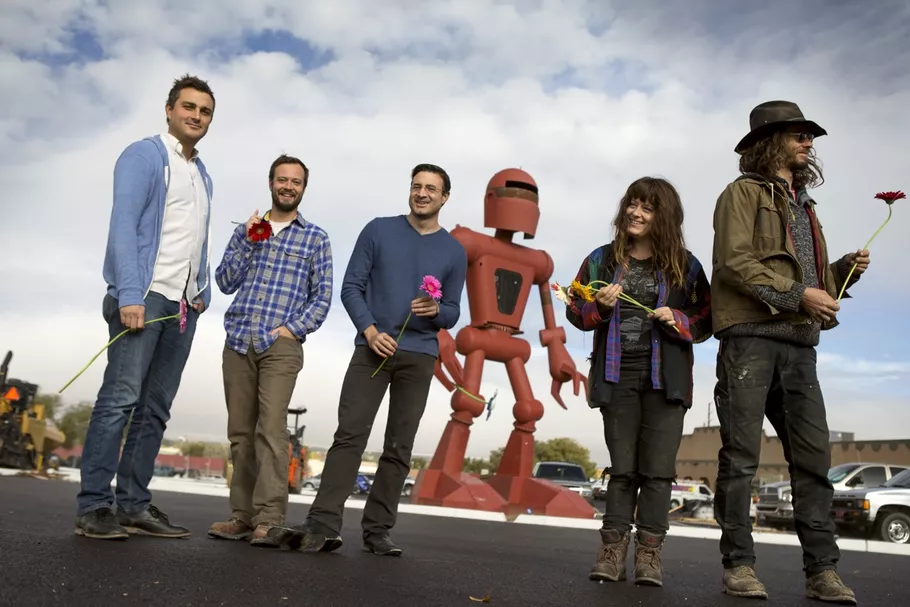
Founding members of Meow Wolf (circa 2015) pose in front of their Santa Fe art complex, which was once a bowling alley. From left: Corvas Brinkerhoff, Sean Di Ianni, Vince Kadlubek, Caity Kennedy, and Matt King. artsy.netnews.artnet.com
Meow Wolf was formed in February 2008 in Santa Fe, New Mexico by a group of young local artists looking to shake up the city’s art scene. “We started out in 2008 as just a DIY group of artists who got together to make art, throw parties, and have music shows in a warehouse in Santa Fe,” recalls co-founder Sean Di Ianni. Most of the founders were in their early twenties – “we rented a dirty warehouse by sharing the rent… and we wanted to make art,” as co-founder Matt King describes. Lacking institutional support or formal training (many hadn’t gone to art school, they banded together as an underground collective of “punk, quirky, artistic pals” making their own venue for art and music.
Key founding members of Meow Wolf included:
Vince Kadlubek – A Santa Fe native who became Meow Wolf’s de facto business leader and first CEO. Kadlubek helped push the collective to grow and secured major investments (he later said his mind was “in the clouds thinking five years down the line” while others handled day-to-day execution).
Caity Kennedy – A co-founder and art director known for her imaginative vision. “We wanted to do crazy things… things that galleries couldn’t sell. We wanted the self-determination of doing our own thing without having to ask for permission,” Kennedy says of their early philosophy.
Emily Montoya – Co-founder and multimedia artist who helped shape Meow Wolf’s graphic style and playful aesthetic (from painting to video, Montoya contributed to the collective’s distinctive look).
Sean Di Ianni – Co-founder who has worn many hats, from artist to organizer. Di Ianni helped steer the group’s operations and later articulated its mission: “Our mission is to inspire creativity in people’s lives so that the imagination can transform our world”.
Matt King – A co-founder and creative force often credited as a philosophical backbone of Meow Wolf. King started out making his own paintings and installations, and later became a Creative Director guiding large teams. (He noted that as Meow Wolf grew, “I hardly touch anything anymore… I have to find people who are more talented than me to actually make it”. He struggled with the transition from doing personal art to directing others, but “now I think I have a pretty healthy relationship with both”.) King was instrumental in developing Meow Wolf’s cosmic narrative and worldview until his death in 2022.
Corvas Brinkerhoff – A co-founder with a background in tech and design. Brinkerhoff helped incorporate interactive tech into Meow Wolf’s exhibits and later led its creative technology teams.
Benji Geary – A founding member (often behind the scenes) who contributed his fabrication and building skills in the collective’s early installations.
From the beginning, Meow Wolf embraced a radically inclusive, collective ethos. There was effectively an open-door policy – any friend or community member who contributed to a project could consider themselves part of Meow Wolf. “Since the beginning, we’ve always been an open door,” says King, describing the collective’s “radically inclusive” membership philosophy. This freeform, anyone-can-join approach fostered a wild creative energy, though it also meant a certain “chaotic, anarchic mess” at times, as Di Ianni admitted of those early days. Even the name “Meow Wolf” captures the group’s playful randomness – it was chosen by pulling two words out of a hat at their first meeting, an appropriately spontaneous christening for an unpredictable art collective.
Early Projects and Growing Ambitions (2008–2015)
In its first years, Meow Wolf made a name locally through a series of DIY art installations and performances, each more ambitious than the last. The collective transformed cheap or found materials into otherworldly environments, often in borrowed or makeshift spaces. Their early projects ranged from “Biome Neuro Norb” (2008), a sci-fi inspired installation in a Santa Fe warehouse, to “Glitteropolis” (2011), which covered a gallery in 50 pounds of glitter. Meow Wolf shows often had fantastical themes and invited audience interaction – long before “immersive art” became a buzzword, this crew was doing it themselves on a shoestring budget.
A major turning point came in 2011 with The Due Return, an installation at Santa Fe’s Center for Contemporary Arts. The Due Return was an enormous two-story “inter-dimensional” ship that Meow Wolf built from scratch inside a gallery space. Visitors could wander its many rooms and imagine the lives of its fictional crew. The exhibit was a smash hit. Over its two-month run, The Due Return drew large crowds and even generated around $200,000 in ticket sales – a huge sum for an art project put on by a young collective. Seeing that their wild ideas could captivate the public and make money, the group began to imagine “something bigger, something bolder, something permanent”. As co-founder Vince Kadlubek put it, “The Due Return” proved that Meow Wolf had the potential to create a sustainable attraction on a grander scale.
Other inventive pop-up exhibits followed. In 2012, Meow Wolf partnered with local high school students to create the original OmegaMart – a satirical “grocery store” installation stocked with absurd fake products (like “Giant Sponge in a Box for Cows that Have Been Abducted”). In 2013 they unveiled “Nucleotide”, an immersive cave-like environment pulsing with pastel colors and soundscapes. Each project built Meow Wolf’s reputation for “immersive, maximalist environments that encourage audience-driven experiences”. By 2015, the collective had grown to encompass dozens of artists, musicians, writers, and technologists. What began as a ragtag crew had swelled into a mini art community with a shared dream: finding a permanent home where their imaginations could run even wilder.
House of Eternal Return: The First Permanent Installation
In 2015, that dream became achievable when an unlikely patron stepped forward. Famed Game of Thrones author George R.R. Martin, a Santa Fe resident and fan of Meow Wolf’s work, purchased a defunct 20,000-square-foot bowling alley and offered it to the collective as a canvas for a permanent exhibit. With Martin’s $3.5 million investment to fund renovations, Meow Wolf finally had a building of its own. The artists spent months transforming the cavernous old bowling alley into an immersive universe unlike anything seen before.
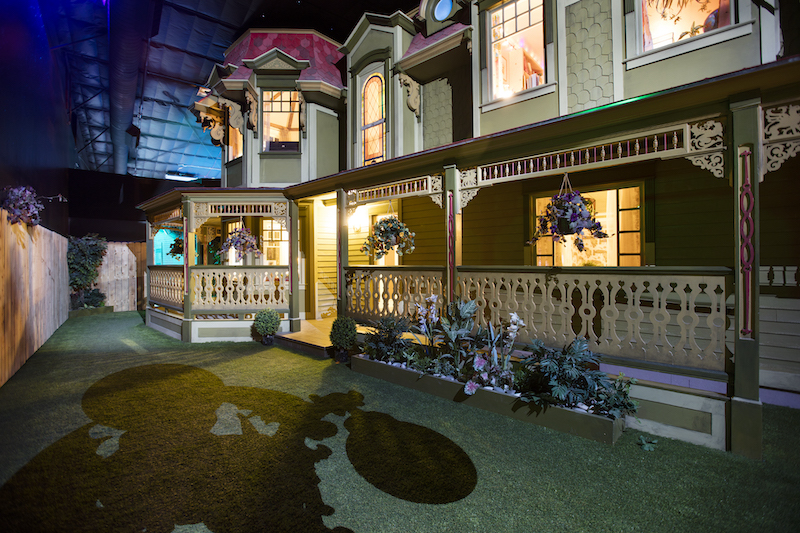
Exterior of the House of Eternal Return in Santa Fe – a seemingly normal Victorian house façade concealing surreal dimensions inside.
House of Eternal Return opened in Santa Fe in March 2016 as Meow Wolf’s first permanent installation. On the outside it resembles a quirky Victorian two-story house, but once you step through the front door, reality frays. The premise is a science-fiction mystery: the house belonged to the fictional Selig family, who have mysteriously vanished after conducting a secret experiment in their home. As visitors explore the house – opening the family’s cabinets, leafing through their journals, poking around their living room – they discover portals to bizarre other worlds. For example, the refrigerator in the kitchen swings open to reveal a glowing tunnel to a neon-drenched space, and climbing into the laundry dryer might deposit you in a starry cosmos. There is no map or set path; guests freely roam through a maze of hidden passages, dreamlike landscapes, and interactive art installations, piecing together clues about the Selig family’s fate.
Crucially, House of Eternal Return was a collective creation on a grand scale. More than 100 local artists collaborated to build the multitude of rooms and artworks within the exhibit. They pooled talents in visual art, sculpture, lighting, audio, film, and even architecture to construct a cohesive yet mind-bending experience. Not everything was polished – the budget was tight and the team was learning as they went. “The artists who worked on the House… didn’t have a lot of money or experience with such a massive project. They learned how to solve problems as they came up and didn’t let imperfections hold up the process,” one account notes. This hands-on, make-it-work attitude gave the House a funky DIY charm. As one team member put it, “The House is so special – it’s got a scrappiness to it that makes it feel unlike any of the other locations… only possible because we were still a small company and not ‘Meow Wolf, The Corporation™’.” In other words, the first Meow Wolf exhibit retained the soul of the collective’s grassroots origins, before the pressures of corporate growth set in.
The public response to House of Eternal Return was overwhelming. In its first full year, the attraction drew about 400,000 visitors – nearly four times more than projected – generating roughly $6 million in revenue. This was far beyond what a typical art museum in a city the size of Santa Fe might see. By 2018, over a million people had visited, and House of Eternal Return was firmly established as Santa Fe’s must-see tourist attraction, often topping travel lists alongside the city’s famous museums. Reviewers described the experience with wonder; part immersive art installation, part exploratory playground, it defied easy categorization. Was it an art exhibit? An indoor theme park? An interactive storytelling game? In truth, House of Eternal Return was a bit of all of these. As the National Endowment for the Arts later wrote, “Call it installation art. Call it immersive storytelling. Call it theater, or theme park, or just straight-up weird… no single term can fully capture the Meow Wolf experience.” It also proved that Meow Wolf’s alternative model for art could be wildly successful on its own terms.
The instant success of House of Eternal Return transformed Meow Wolf virtually overnight. The collective suddenly had a sustainable income stream and an international profile. Santa Fe – a city known for its established fine arts and folk art markets – was now also known for a trippy explorable fun-house in an old bowling alley. Importantly, profits from the exhibit were funneled back into the organization, funding artist salaries and new projects. Meow Wolf began hiring many of its once-volunteer contributors as paid staff. “We have 20-year-olds making $50,000 a year with us,” one art director noted in 2017, highlighting that “increasing precarity for young artists” made Meow Wolf’s job-creating model attractive. By providing stable, paid work for artists – “most of whom are in full-time positions” with benefits – Meow Wolf was bucking the norm of the starving artist. This ethos of valuing artists’ labor became a core part of their vision.
Vision and Philosophy of the Collective
Despite Meow Wolf’s growing profile, its members maintained that they were artists first and were driven by a mission, not by money. The collective’s guiding vision was to create art that anyone could connect with, outside the elitist confines of galleries or academia. Co-founder Caity Kennedy recalls that they deliberately set out to do the kind of art “galleries couldn’t sell,” in order to break free of the fine art market’s constraints. In Santa Fe’s insular art scene, they felt there was no place for young, experimental creators like themselves – so they made their own place. “Meow Wolf was started because this group of artists didn’t want to fit into the fine arts world… so they found their own place and made their own rules, where no one had to question if they belong or not,” one company history explains. This meant welcoming all styles and mediums, and inviting audiences to experience art in a playful, hands-on way rather than as passive observers.
Inclusivity and community were thus baked into Meow Wolf’s DNA. “We have geared what we have done to inspire as many people as we can, and to offer employment to the most artists that we can,” says Matt King, articulating the group’s underlying philosophy. The Meow Wolf team felt traditional galleries and museums reached a narrow audience and left most working artists “out in the cold,” whereas their approach could engage whole families, young and old, and involve dozens of creators at once. By designing immersive environments with wide appeal, they hoped to ignite creativity in visitors who might never set foot in a conventional art gallery. “Our mission is to inspire creativity in people’s lives through art, exploration, and play so that imagination will transform our worlds,” reads the Meow Wolf mission statement – an almost utopian goal of changing the world via imagination.
Crucially, Meow Wolf’s artists insist that accessible does not mean watered-down. Their work can be whimsical or surreal, but it also embraces complexity and even darkness. “We haven’t watered down our ideas for the public,” co-founder Emily Montoya (an illustrator and designer) told an interviewer. Instead, Meow Wolf’s strategy is to offer such a variety of art and story elements that almost anyone will find something that speaks to them. “We can cater to a wide audience without even trying, just by having a wide array of projects by a wide array of artists,” explains Kennedy, noting that the eclectic, multilayered nature of Meow Wolf’s spaces organically provides both family-friendly fun and deeper intrigue. In other words, a visitor can enjoy the flashy visuals and interactive gadgets on a surface level, or they can probe the hidden narrative and subtexts if they wish – there’s no wrong way to experience it.
Meow Wolf’s philosophical bent often veers into the existential and metaphysical. Many of the stories and worlds they create explore themes of multiverses, hidden realities, and the power of imagination to alter one’s perception. Co-founder Matt King once half-jokingly contrasted Meow Wolf’s ethos with that of Disneyland: “Disney’s mantra is ‘the happiest place on earth.’ I think if we had one, it would be ‘Meow Wolf: existentialism.’ We’re going to show you that life is pain, but in that pain, there is beauty and wonder.” He and his collaborators believe art shouldn’t shy away from the chaotic, mysterious, or even eerie aspects of life. “There should be happy and hopeful things and fucking dark things,” King says. “Blurring that line is part of what we’re doing.” By mixing light and dark, whimsy and profundity, Meow Wolf aims to give audiences an experience that, as King puts it, makes you “walk out questioning what is real… We don’t want doom and gloom, but we do want people to remember how special and exciting and crazy it is just to be alive.” This almost spiritual view of art’s role – to wake people up to the wonder (and responsibility) of existence – drives the collective’s creative decisions as much as any business plan.
Finally, Meow Wolf views storytelling as a vital layer of its art. Beneath the spectacle of its installations, the collective has been quietly building a kind of Meow Wolf mythology – a connected universe of characters and lore that spans exhibits. For example, the House of Eternal Return introduced the mysterious Selig family; the later Omega Mart exhibit in Las Vegas and Convergence Station in Denver added new fictional corporations and cosmic beings. The public is never spoon-fed the full story, but dedicated fans can discover and piece together the narrative through clues and even an online fan-made “Meow Wolf-pedia.” “We’ve been talking about [our story universe] loosely since we started,” says King, “but we never got too deep into it until we opened the House… Once the House opened and we proved that the business could be successful, then we really started digging into those ideas.” In short, once financial stability was achieved, the artists could spend more energy on complex world-building. Meow Wolf’s dream is to create an immersive “Marvel Cinematic Universe” of art – an original narrative multiverse that audiences can explore piece by piece across different installations. Even so, the core goal isn’t to push a plot on visitors, but to invite curiosity. “We create an opportunity for people to be explorers… When you come inside a Meow Wolf exhibition, you’re finding clues, you’re venturing into unknown spaces. That excites a part of humans that we have long forgotten about,” says Vince Kadlubek. “At the heart of it, we’re all scientists.” In Meow Wolf’s view, art should reactivate our innate curiosity and sense of play – the same impulses that fueled the collective’s own formation back in 2008.
From Collective to Company: Success and Growing Pains
The runaway success of House of Eternal Return propelled Meow Wolf into a new phase. Practically overnight, the ragtag art collective had to become a structured company to handle its revenues, expansion plans, and the hundreds of employees and artists now on its payroll. Meow Wolf officially incorporated as a for-profit company (albeit a socially-minded one) and even registered as a public-benefit corporation. In 2017, it earned certification as a B Corporation, meaning it is legally committed to high standards of social and environmental performance as well as profit. This move aligned with the founders’ ideals – they wanted to prove that an arts business could make money and still “give back to its community” and treat creators equitably. For example, Meow Wolf instituted revenue-sharing and bonuses for artists and offered robust benefits. The collective’s credo became that “accomplished artists must be compensated on an equal level with other skilled, in-demand professionals”. In other words, art isn’t free – artists deserve a good living, and a successful art company should nurture its creative community, not exploit it.
Yet growth brought inevitable growing pains. By 2017–2018, Meow Wolf raised over $50 million from investors to fund new permanent exhibitions in Las Vegas, Denver, and beyond. The staff ballooned; from just a couple dozen core members in 2015, Meow Wolf expanded to around 200 employees in 2018 and 900 employees by 2021. Many of the original artists suddenly found themselves in a full-fledged corporate environment with HR departments, executive officers, and fast-paced development schedules for new locations. The shift required imposing more order and hierarchy than the loose collective had before. “There have been exponential changes since [2008]… a massive learning curve for any of us who have been around since the early days,” says Di Ianni of the transition. The co-founders, who once did a bit of everything, had to become managers and executives. “My trajectory has been increasingly less hands-on,” Di Ianni notes – building huge exhibitions meant “we had to design those things and organize ourselves around the process”, a far cry from ad-hoc art jams in a warehouse. Matt King likewise found himself “more [of a] director” than an artist, coordinating teams of specialists. In late 2019, CEO Vince Kadlubek surprised many by stepping down, saying the company had entered a phase where “we need to get execution focused, and my mind is in the clouds… it was distracting”. He acknowledged that Meow Wolf now had senior professionals “more experienced” at running operations, and that his strength was big-picture vision rather than day-to-day execution. This was emblematic of the collective’s evolution: the freewheeling creative leaders had to adapt to more structured roles or make way for seasoned operators to guide the rapid expansion.
Internal tensions accompanied this growth. In 2020, as Meow Wolf scaled up, some employees voiced concerns that the workplace had become stressful and inequitable. There were even allegations of “toxic” dynamics in management and instances of pay disputes. In one high-profile case, Meow Wolf faced a lawsuit from a former member over discrimination claims (the collective settled the case). More broadly, a number of staff felt that the company’s rapid corporatization was at odds with its funky, communal origins. These pressures culminated in employees across different Meow Wolf locations attempting to unionize. In early 2021, a group called the Meow Wolf Workers Collective formed and workers in Santa Fe voted to unionize, seeking a greater voice in decisions, better transparency, and job security – especially after a round of painful pandemic-related layoffs in 2020. Some staff accused leadership of initially resisting the union; a leaked job posting even appeared to task a manager with “discouraging organizing in non-unionized parts of the company,” causing an outcry. Meow Wolf’s founders scrambled to reassure their team. “That was horrible. That job posting was not in any way a reflection of how we want to approach the union,” Di Ianni said, noting it was posted by someone no longer with the company. He and King maintain that they support the workers’ rights: “Some of these people have been our friends for 15 years… I see the union as an opportunity… if we can work together, it’ll make us stronger,” Di Ianni emphasized. King acknowledged there was a “difference of opinion on how we go about” ensuring employees are happy and passionate, but “we all want what is best for the people that work on this thing”. By late 2021, Meow Wolf’s leadership was sitting down with the new union to negotiate, determined to find a balance between being a artist-driven organization and a well-run business.
Along with internal strife, Meow Wolf also faced external skepticism as it rose to fame. Some critics in the traditional art world were dubious of the collective’s popularity and populist approach. The group’s emphasis on spectacle and immersive “experience” drew accusations of being more entertainment than art. One Santa Fe arts writer even labeled Meow Wolf “toxic to fine art,” worrying that its success signaled a trend toward sensational, Instagram-friendly installations over serious artistic merit. Others questioned the authorship of Meow Wolf’s works – since dozens of people collaborate on each exhibit, old notions of the lone artistic genius don’t quite apply. Meow Wolf’s founders, however, never seemed fazed by the art-establishment haters. “The whole thing is an art project,” they countered – meaning the business, the exhibit, the community, all of it is their art. In interviews, co-founders like King and Di Ianni have asserted that what they do is art, even if it doesn’t fit neatly in existing categories, and they don’t mind if some critics don’t get it. In fact, the collective sees itself as pioneering a “vital and necessary” alternative model, one that makes the arts more accessible and exciting for new audiences. As King put it, elitist attitudes in galleries only “turn away members of the general public”, whereas Meow Wolf’s open-armed approach brings art to people who might otherwise feel unwelcome or uninterested. By 2022, Meow Wolf’s impact on the broader arts scene was being acknowledged with awards, and even once-skeptical art critics were coming around as similar immersive art spaces popped up around the world.
Still, the challenge of maintaining Meow Wolf’s soul during explosive growth has been very real. “Meow Wolf represents the paradox,” says Noah Nelson, an outside observer who founded an immersive art blog. “It was born from a wild artist collective that created these family-friendly psychedelic sandboxes. It morphed into a business that became increasingly a business and is still trying to hold onto that… energy. It’s a tightrope that is very hard to walk, and it has at times been downright scary to watch them walk it. The upside is that they’re still walking it.”. This encapsulates the delicate balance Meow Wolf’s team has tried to strike: scaling up and professionalizing without losing the creative chaos and wonder that made the whole thing special in the first place. Even co-founder Sean Di Ianni admits that people often romanticize the collective’s early days, but “it wasn’t [utopia]. It was a chaotic, anarchic mess… I guess what I’m saying is, it’s always been a struggle.” Building something as complex as Meow Wolf – whether as a scruffy collective or a big company – has never been easy. Yet the struggle has yielded unique rewards: new worlds that audiences can literally step into, and a new way for artists to thrive.
Art, Money, and the Meow Wolf Way
At the intersection of art and money, Meow Wolf has tried to prove that the two need not be enemies. The collective’s evolution shows an ongoing negotiation between order and chaos. In the beginning, creative chaos reigned – an anything-goes art free-for-all with no rules or revenue. In the present, careful order must augment the chaos – payrolls, construction schedules, fire codes, and investor expectations are very real constraints. The tension between these forces has sometimes caused friction (as seen in union disputes or founder burnout), but it has also been productive. The structure and funding allow Meow Wolf to manifest dreams on a scale that pure chaos never could; the chaos and creative risk-taking ensure that Meow Wolf’s projects remain authentic labors of love rather than cookie-cutter corporate products.
The members of Meow Wolf are acutely aware of walking this tightrope. They have deliberately instilled mechanisms to keep the company true to its roots: for example, ensuring that several original co-founders remain at the helm to guide the creative vision even as MBAs and executives join the ranks. In fact, as of 2021, seven of the initial founders (Di Ianni, Brinkerhoff, Geary, Kennedy, King, Kadlubek, and Montoya) were still with the company in various leadership roles. This continuity has helped Meow Wolf preserve its identity. The group also continues to invite community participation – hiring local artists in each new city they open in, and offering grants and support for community art programs through a charitable foundation it launched in 2022. In short, they are trying to grow responsibly, without losing the sense of play and community that got them started.
Meow Wolf’s journey from a bunch of friends in a warehouse to a nationally recognized creative powerhouse is a testament to the power of big ideas (and a bit of serendipity). They tapped into a public hunger for immersive, interactive art experiences that traditional institutions weren’t providing, all while staying true to many of their countercultural principles. “We wanted somewhere to experiment with our creativity and play around in,” the collective says – and that spirit is still evident in their exhibits’ chaotic mashup of art and fun. At the same time, they’ve shown that embracing business can amplify art’s impact: Meow Wolf’s projects have provided meaningful employment to artists and reached millions of people who leave inspired. As an insider noted, “It was kind of a perfect storm of people, place, and time that supported, produced, and opened the portal that carried us to where we are today.” The portal is open now, and Meow Wolf stands as both a thriving company and a living work of art in progress.
Looking ahead, Meow Wolf continues to expand (new permanent exhibitions have since opened in Las Vegas, Denver, and Texas, with others on the horizon). Each new location presents the collective with the task of scaling that mountain of chaos and order once again. If the past is any indication, they will approach it with the same boldness and creative fervor that has defined them from the start. The Meow Wolf team often says they see their mission as using art to “spark the imagination” and encourage people to “make a positive change in the world”. That mission, born in a Santa Fe warehouse and tempered by years of trial and error, remains their north star. In a world where art and entertainment are increasingly mingled, Meow Wolf has managed to carve out a unique space – one where meow meets wolf, where chaos meets community, and where art and enterprise learn to coexist in a colorful cosmic playground.
After the House
What lingered most, days later, wasn’t any single room or puzzle or visual flourish. It was the recognition that the House of Eternal Return isn’t just a place you walk through. It’s a question you walk out carrying. Every creative project that starts in chaos eventually collides with the same problem:
How to survive success without being domesticated by it?
The Meow Wolf story—when viewed whole—doesn’t read like a clean victory or a clean compromise. It reads like a permanent negotiation. Between play and process. Between intuition and infrastructure. Between the joy of making something impossible and the responsibility of sustaining it for others.
“Order”, in this framing, isn’t the villain. It’s the thing that keeps the lights on, the doors open, the artists paid.
But “chaos” is the source. And sources don’t like being managed.
What struck me, leaving the exhibit, is how honest that tension felt. Not resolved. Not sanitized. Just exposed. Encoded into the work itself. You can feel it in the way the House invites you to skim—or dares you to go deeper. In the way most visitors leave delighted, and a select few leave quietly shaken.
That ratio isn’t accidental.
It mirrors something I recognize uncomfortably well.
Creative adulthood, it turns out, is not about choosing chaos or order. It’s about deciding how much of each you’re willing to live with, and what you’re willing to lose in the bargain.
Most systems reward clarity, scale, repetition.
Most meaningful creative work begins in confusion, excess, obsession.
Meow Wolf didn’t solve that contradiction.
They built a cathedral inside it.
And maybe that’s the only honest outcome available: not purity, not collapse—but a structure sturdy enough to hold wonder, even as it leaks.
As we left Santa Fe, I kept thinking about that instinct I’d voiced earlier—the desire to simply absorb, not extract. To resist turning experience into output.
Of course, per the BORG, resistance was indeed futile.
I failed.
But failure was always the point. I can never avoid meaning-making, but I should notice when it turns extractive. To ask—again and again—whether the systems we build are still in service of the chaos that birthed them.
The House doesn’t answer that question.
But it does leave the door ajar.
Sources:
Artsy, “This 140-Person Art Collective Is Pursuing an Alternative Model for Artists to Make a Living,” Jul. 10, 2017 artsy.netartsy.netartsy.net.
Artnet News, “‘The Whole Thing Is an Art Project’: Meow Wolf Cofounders Explain the Grand Plan Behind Their Wildly Popular Immersive Art Universe,” Oct. 19, 2021 news.artnet.comnews.artnet.comnews.artnet.comnews.artnet.com.
Meow Wolf: Origin Story (company blog), “House of Eternal Return: The Original Meow Wolf,” Aug. 16, 2022 meowwolf.commeowwolf.commeowwolf.com.
National Endowment for the Arts Magazine, “Investing in Creativity: Meow Wolf’s New Vision of Artistic Space,” 2018 arts.govarts.govarts.gov.
Los Angeles Times, “Meow Wolf supercharged the way we experience art. Is L.A. ready for it?” May 3, 2024 latimes.comlatimes.com.
Santa Fe Reporter, “Vince Kadlubek Steps Down as Meow Wolf CEO,” Apr. 17, 2020 sfreporter.com.
Meow Wolf Official Site – About & Community Pages meowwolf.commeowwolf.com.